
Short answer
Commercial solar in the Philippines should be designed for self-consumption, not export: self-consumed output avoids the full retail rate (roughly ₱10–₱12/kWh for Meralco customers) while exports are credited at the blended generation rate (about ₱5–₱7/kWh), so it takes close to two exported kilowatt-hours to offset one bought at night. Keep 100 kW as the safe net metering planning assumption, and treat the reported move toward 1 MW as unconfirmed until your distribution utility confirms it in writing.
Philippine commercial solar is often sold on the retail tariff and financed on a different number. That gap is where most payback projections go wrong.
Self-consumed solar avoids the full retail rate — roughly ₱10–₱12/kWh for Meralco customers. Exported solar is credited at the blended generation rate, around ₱5–₱7/kWh. In other words, it takes close to two exported kilowatt-hours to offset one bought at night. Any commercial solar Philippines design that maximises export instead of self-consumption is optimising for the wrong rate.
The cap question: 100 kW, or 1 MW?
Under the Renewable Energy Act (RA 9513) and ERC Resolution No. 09, Series of 2013, net metering has long been applied to systems up to 100 kW. Most installers, utilities and legal summaries still cite that ceiling, and it remains the safe planning assumption.
In 2026, industry sources reported a DOE circular that would lift the commercial and industrial cap toward 1 MW and shorten distribution utility approval to ten working days. Other Philippine solar guides note this is not confirmed by DOE or mainstream reporting and advise confirming the limit with the distribution utility before sizing above 100 kW.
Our position: design as if the cap is 100 kW, and confirm your specific utility's current position in writing before you commit to anything larger. A project whose economics depend on an unresolved rule change is a project with an unpriced risk. Verify with your distribution utility (Meralco, VECO, Davao Light or your cooperative) before signing.
Regulatory position summarised from ERC Resolution No. 09 s.2013 and 2026 Philippine solar industry reporting; not legal advice. Confirm current rules with your distribution utility and the Energy Regulatory Commission before sizing above 100 kW.
Design for self-consumption, not export
Once you accept that exports are credited at roughly half the retail rate, the design objective becomes obvious: put as much of the array's output as possible into your own daytime load.
Practically, that means sizing against the daytime load curve rather than the whole bill, and being honest about the evening. A factory running three shifts self-consumes a large share of output. A warehouse that is quiet until 6 pm does not — and for that profile, storage or load shifting is what moves the number, not a bigger array.
| Item | Value | Implication |
|---|---|---|
| Retail rate avoided by self-consumption | About ₱10–₱12/kWh (Meralco) | Size against the daytime load curve, not the whole bill |
| Export credit | About ₱5–₱7/kWh blended generation rate | Two exported kWh offset roughly one bought at night |
| Net metering cap | 100 kW under RA 9513 and ERC Resolution No. 09 s.2013 | Safe planning assumption; confirm in writing above 100 kW |
| Reported 2026 proposal toward 1 MW | Not confirmed by DOE or mainstream reporting | An unpriced risk if the payback depends on it |
| Wind load | Typhoon belt — mounting specified to a calculated wind load | Rail spacing, clamps, sheet profile and purlin fixing all follow from it |
| Contractor licence | PCAB licence with renewable energy classification | Verifiable, and it decides whether the system is energised |
Rate ranges are public Philippine figures for orientation only; regulatory position summarised from ERC Resolution No. 09 s.2013 and 2026 industry reporting, not legal advice.
The roof is a structural problem before it is a solar problem
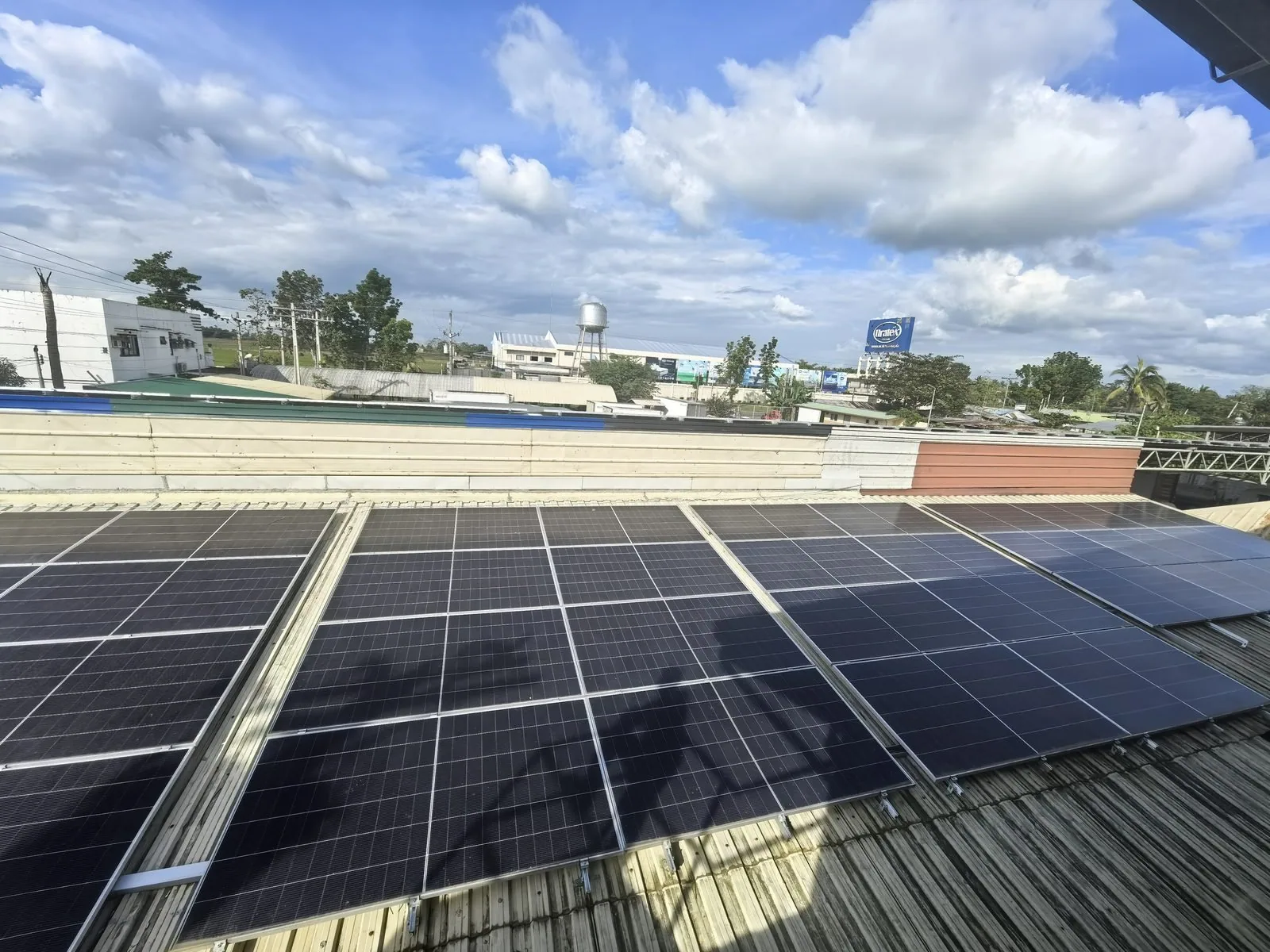
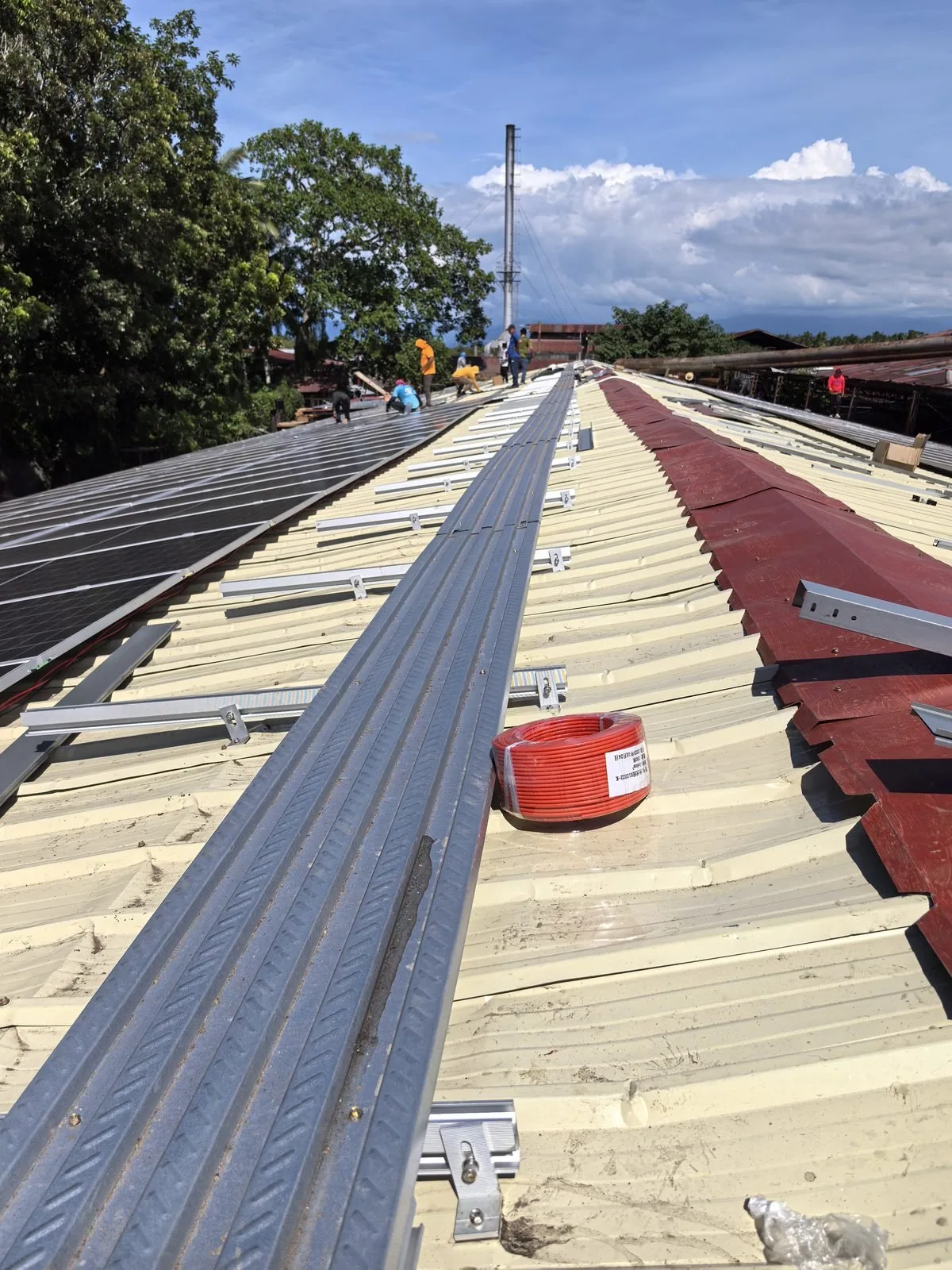
The Philippines sits in a typhoon belt, and the wind load case governs the mounting design. Rail spacing, clamp type, sheet profile and the fixing into the purlins are specified against a calculated wind load, not copied from a milder climate.
The same survey also has to answer: usable area after setbacks and shading, the condition of the metal sheets, roof penetrations and waterproofing, and where the cable route runs to the inverter room. On a large roof we also plan the maintenance walkway at design stage — an array with no safe access route stops being cleaned and inspected within its first year.
Permits, and the contractor licence that matters
The compliance stack is not optional: a professional electrical engineer signs the single line diagram, the distribution utility runs a distribution impact study, the ERC issues a Certificate of Compliance, and the LGU issues the Certificate of Final Electrical Inspection before the bi-directional meter goes in.
One detail buyers miss: the installing contractor should hold a PCAB licence with the renewable energy classification. It is easy to verify and it is the difference between a system a utility will energise and one that stalls at interconnection.
What we need from you
- Twelve months of bills, including peak and off-peak consumption
- Your distribution utility and contracted capacity
- Daytime operating hours and the loads that run in them
- Roof drawings or dimensions, plus photos of the sheet profile
Send them to info@forcesolarpower.com or over WhatsApp and we will come back with a sized architecture rather than a price per kilowatt. Related: 100kW solar system, 400kW solar system, how a 400 kW rooftop build comes together.
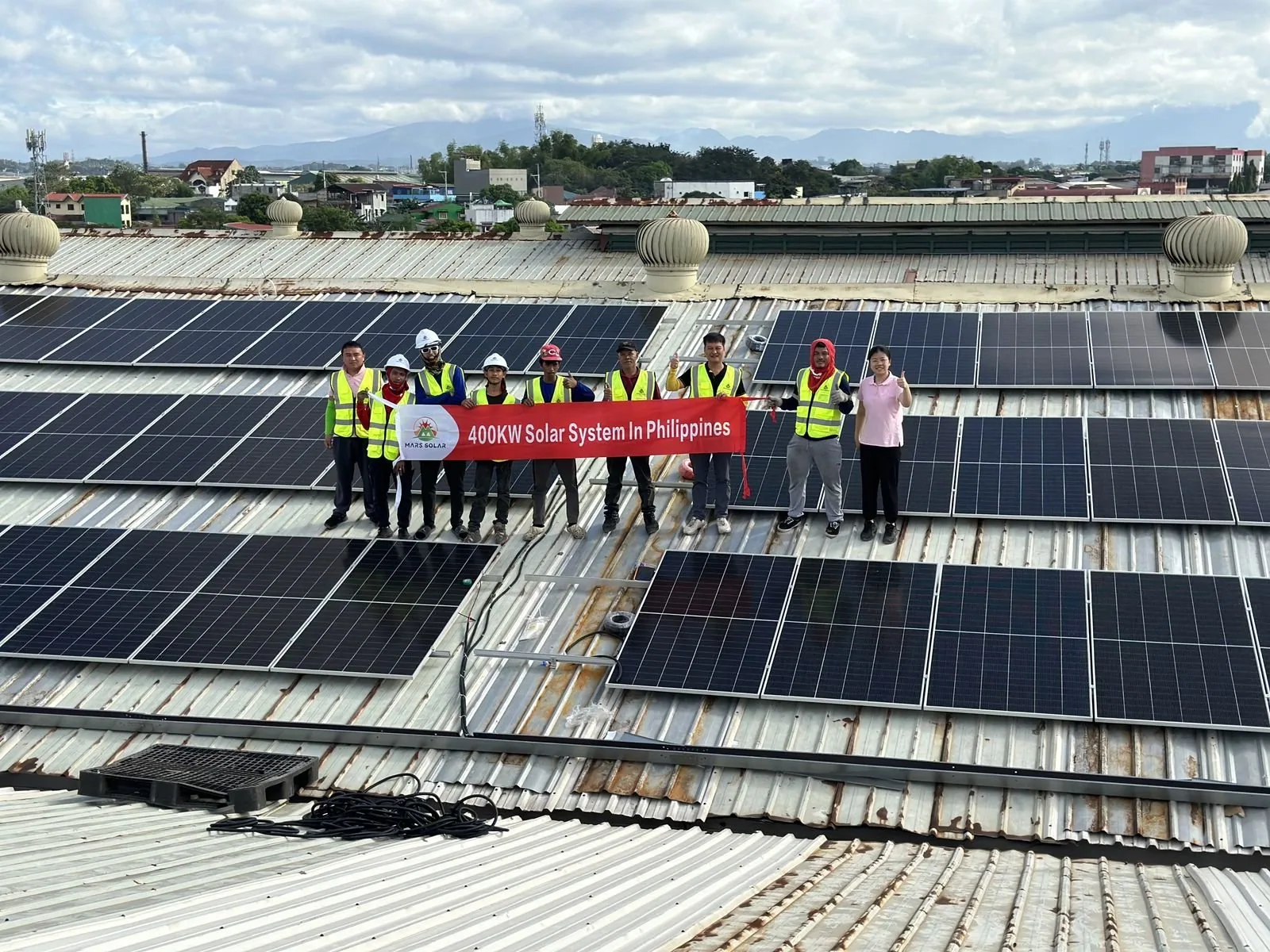
Photographs from Force Solar installation records. Figures describe the referenced project configuration; every new system is sized against its own load data.