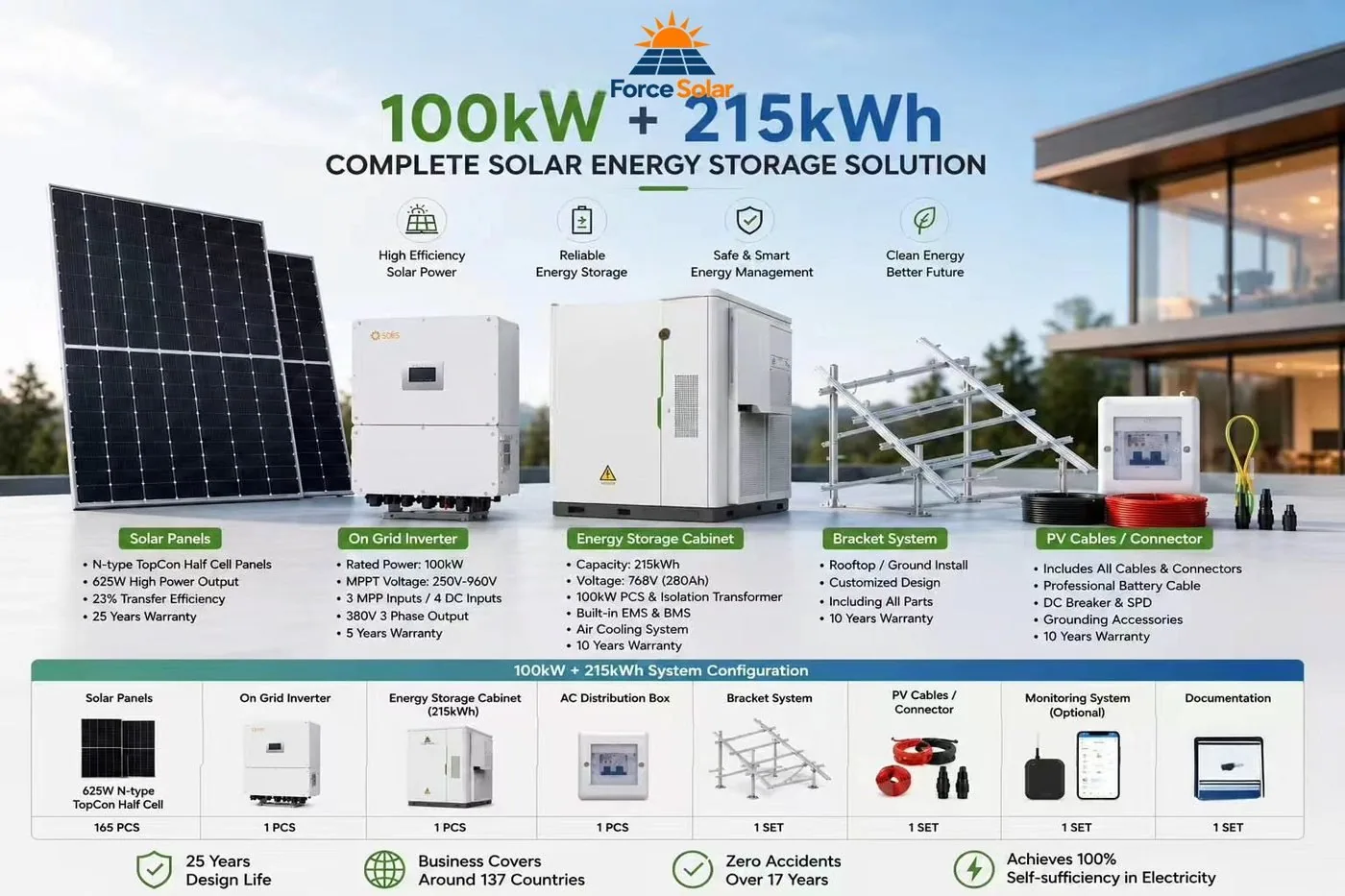
A complete 100kW solar power system — PV modules, inverter, mounting, protection and export packing, configured around your load and destination. Hybrid-ready: add battery storage now or later.
Every proposal names each component and its role in the complete system.
Component
Details
Solar panels
160 × 630 W N-type TOPCon half-cell modules = 100.8 kWp DC array; 25-year linear power warranty
Combiner
6T-384V — multi-string PV combiner, 1,000 V DC maximum input
Hybrid inverter
100 kW three-phase, 380–400 V; battery voltage window 300–950 V; MPPT range 150–850 V
Battery storage
LFP battery bank, 384 V / 628 Ah = 241.15 kWh reference capacity; >6000 cycles
Distribution box
Circuit breakers, disconnectors and surge protection, self-supporting overload protection
Mounting system
Rooftop or ground, all parts: maintenance walkway, cable tray and grounding flat iron — engineered to site wind load
Cables & connectors
Battery cable with terminals, PV cable, grounding cable and MC4 connectors
Export packing
≈ 30 CBM, 9864 kg per set
Monitoring (optional)
IoT remote monitoring with mobile app for generation and alarm tracking
~400 kWh per day in good sun — size against your own peak-sun-hours
Fits a standard 40HQ container with all accessories
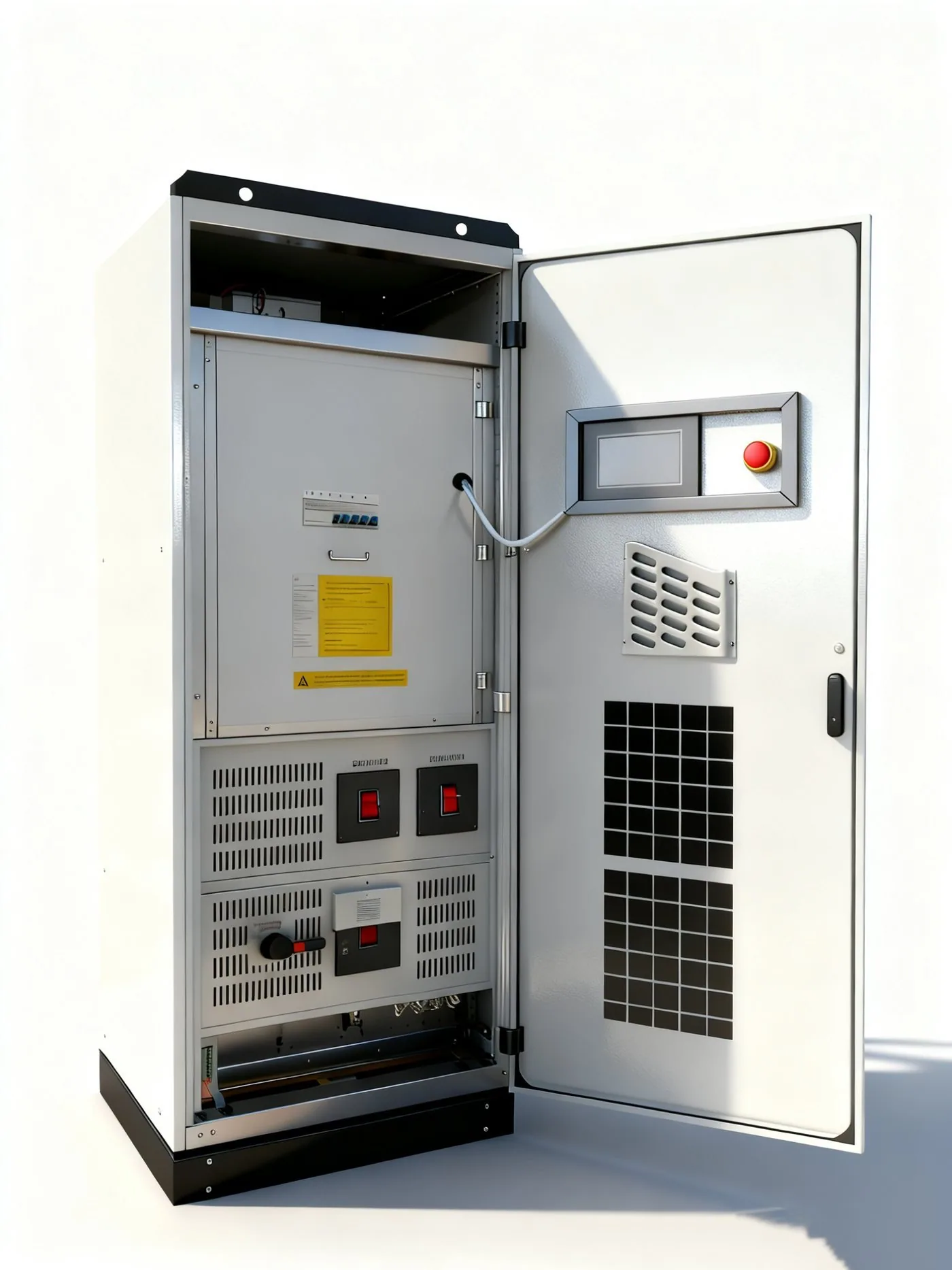
Hybrid-ready — add an LFP battery cabinet anytime
Engineered mounting for flat or pitched roofs
What a 100kW solar system can power
At roughly 400 kWh per day in good sun, a 100kW system is sized for sites whose daytime consumption sits in that range — business with steady operating hours. The right capacity is always checked against interval load data, not the nameplate alone.
Where the grid is unreliable, the same PV array pairs with a hybrid inverter and battery bank so critical circuits stay live through outages.
How we configure a 100kW project
Each proposal starts from your electricity bills or load list, the grid voltage and phase, roof or land area, and the destination port. The bill of materials names exact models, the single-line diagram shows how they connect, and the order file carries the inspection records.
PRICE & PAYBACK
What drives the price and the payback.
Industry-typical figures for budget planning. A firm price follows the confirmed bill of materials and destination.
Cost factor
Typical figure (2026)
Solar modules
$0.28–0.48 per watt FOB, tier-1 supply
Sea freight & landed cost
Typically +20–35% over FOB to West Africa / Southeast Asia ports
Storage share
35–50% of total system cost where batteries are included
Payback
3–5 years against grid power; under 18 months when replacing diesel
Reference figures, not an offer. Tariff structure, demand charges, roof condition and destination change every project. Product photographs show factory kit configurations; final equipment appearance, rating, labelling and packing follow the ordered model.
TECHNICAL FAQ
Product FAQ
These answers describe system selection. Final equipment and compliance depend on the agreed model and destination.
Does this system work during a power outage?+
A standard grid-tied inverter shuts down when the grid fails. For backup, choose the hybrid configuration with a battery bank and protected circuits — sized to the loads that must stay on.
Can I add batteries later?+
Yes — the system is hybrid-ready. State the storage plan before ordering so the inverter and switchgear are specified for it.
What decides the final price?+
PV capacity, inverter topology, battery energy, mounting type, destination freight and documentation. The payback table shows the industry-typical ranges.
How long does it take to deliver the 100kW Solar System?
End to end, 4–12 weeks. Requirement definition takes 1–3 days, system design 1–2 weeks, production 1–3 weeks, then every unit completes a 72-hour test before shipping, and shipping and installation take 2–6 weeks depending on the destination.
Is the 100kW Solar System configuration fixed?
No. What is shown on this page is the reference configuration for the model — every system is sized against its own load data before it is quoted.
What testing does the 100kW Solar System go through before shipping?
A 72-hour test. It is the fourth of five steps in our delivery process: requirement definition, system design, production, testing, then shipping and installation.
Is 400 kWh a day what the 100kW system really produces?
400 kWh is the DC-side arithmetic: 100kWp of modules × 4 peak sun hours, before anything is subtracted. What reaches your meter is lower, because module temperature above the standard test condition, cable and inverter losses, soiling and any shading all come off the top — and how much each one costs you depends on the site. We write the yield assumption into the proposal, so the payback is worked out on the same basis you will later be measured against.
What is included in the 100kW Solar System price?
Every component named on the quotation, plus factory assembly, the 72-hour test, export packing and the documentation set. Not included: sea freight, import duties and taxes, and site labour. Each quotation lists these on separate lines, so you can compare suppliers on the same basis.
Is installation included with the 100kW Solar System?
Not as on-site labour. Our scope: the equipment as specified, tested before it ships, with the drawings and documentation your contractor works from, plus remote commissioning support and spare parts. Your scope: the base and civil works, crane placement, AC cable runs, the grid-connection cabinet and metering, local permits, and the installation labour. We do not keep installation crews abroad, so site work and its cost are quoted by your own contractor or local EPC.
START A PROJECT
Need a custom configuration?
Send the load profile, grid conditions and destination port — we respond with a sized bill of materials.