
Short answer
Saudi Arabia commercial solar is priced by what you consume, not by what you generate. Surplus exported to the Saudi Electricity Company grid is credited at 5 halalas per kWh under net billing, while the retail tariff it displaces runs up to about 32 halalas for commercial customers and 20 halalas for industrial ones. That gap — roughly six to one — is the single most important number in a Saudi Arabia commercial solar design, and it means the array should be sized to the daytime load curve, not to the roof.
The Kingdom is one of the few markets where the solar resource and the subsidy structure pull in opposite directions. Irradiance is among the best in the world, but retail electricity has historically been cheap, so the business case for Saudi Arabia commercial solar rests almost entirely on the spread between the tariff you avoid and the export credit you are paid. Getting that spread right is the whole of a Saudi Arabia commercial solar business case; everything else is engineering detail.
The Saudi Arabia commercial solar tariff and the 5 halala export credit
Under the SERA Small-Scale Solar PV framework, self-consumed generation offsets your bill at the applicable tariff. Industrial customers sit on tiered tariffs running up to roughly 20 halalas per kWh; commercial customers on tiers running up to about 32 halalas. Anything you export is credited at a flat 5 halalas per kWh, settled by the Saudi Electricity Company through net billing.
| Use | Approximate rate | Relative to export |
|---|---|---|
| Retail tariff avoided — industrial, top tier | ~20 | About 4× the export credit |
| Retail tariff avoided — commercial, top tier | ~32 | About 6× the export credit |
| Surplus exported (net billing) | 5 | 1× |
Tariff tiers and the net-billing rate are the published figures cited from SERA and Saudi Electricity Company material, checked October 2026. Your own invoice governs; tariffs are tiered and subsidised, so the effective rate depends on your consumption band.
Read that table from the buyer's side and the conclusion is uncomfortable but useful: a kilowatt-hour you sell is worth about a sixth of a kilowatt-hour you use. Oversizing the array past the daytime load does not create a bigger saving — it creates a bigger capital outlay with a much weaker return on the marginal kilowatt-hours.
Four capacity caps that shape a Saudi Arabia commercial solar design
The framework sets limits that are not about engineering at all. They are regulatory, and they bind before the roof does.
- A single installation may not exceed 2 MW. Above that you leave the Small-Scale framework and enter the General Self-Consumption framework, which requires a connection study and materially more regulatory engagement.
- One consumer — identified by CR number — may install up to 5 MW in total across multiple premises within a single Electricity Department area.
- Installed capacity cannot exceed the contracted load at each site. You cannot use a small contracted load as the anchor for a large array.
- Grid caps sit above you. Solar capacity is limited to 15% of the transformer rating, and aggregate solar in a distribution area to 3% of the prior year's peak demand.
For most factory and warehouse buyers the transformer cap is the one that bites in Saudi Arabia commercial solar. It is worth checking before the design is drawn, because a rooftop that looks ideal on satellite imagery can be ruled out by the upstream transformer before a single bracket is quoted.
Why self-consumption sizing beats export sizing in Saudi Arabia commercial solar
'Two systems of the same capacity can differ by a wide margin in annual benefit, and the difference is usually not the hardware. It is how much of the generation lands inside the load curve.
| Profile | Generation consumed on site | Surplus exported | Effective value per kWh |
|---|---|---|---|
| Daytime-heavy factory, single shift | Most of it | Little | Near the retail tariff |
| Evening-heavy operation, or three-shift with low daytime draw | Less of it | More of it | Weighted toward the 5 halala credit |
This is where the load profile matters more than the irradiance figure in Saudi Arabia commercial solar. Interval data — or at minimum a daytime meter reading — tells you which column your operation sits in. Without it, any payback number is a guess wearing a spreadsheet.
The approval route and what it costs in time
The process runs through the SEC Shamsi portal, and the Ministry of Energy qualifies contractors and consultants on that platform. The sequence is: initial solar permit application, a site visit to confirm approved capacity, detailed design submission, construction permit, a second visit to inspect and install the meter, then the connection agreement. Published guidance puts end-to-end approval at roughly 30 to 60 days, with the bidirectional main meter installed at no additional cost; systems above 100 kW need a dedicated generation meter at the customer's cost.
Two practical consequences for a buyer importing equipment for Saudi Arabia commercial solar. First, the qualified contractor requirement means your local installer is not optional — and the platform records who they are. Second, because approval follows the design, equipment selection should be settled before submission, not during.
Importing equipment for a Saudi Arabia commercial solar project
Saudi Arabia applies the GCC common customs tariff, with solar modules and inverters classified under HS 854140, 854143 and 850440 at duty in the 0–5% band, and no anti-dumping or countervailing duties currently applied to Chinese solar products. VAT is 15%. Certification commonly required for the market includes IEC 61215 and IEC 61730 for modules, plus G-Mark and SASO conformity.
One caution for buyers who assume a subsidy will cover the gap: the Saudi Content and Localization programme applies a price preference of roughly 10–15% for locally assembled or manufactured components in government-funded projects. For a private factory this is usually not the deciding factor, but for any project with public funding it changes the comparison.
What Saudi Arabia commercial solar does not fix
The grid in the Kingdom is comparatively reliable, so the case here is a cost case rather than a resilience case. Where outages do matter — remote sites, or operations that cannot stop — storage is a separate line and should be sized against the load that has to stay on, not against the array. Dust and heat are the two mechanisms that erode yield over time, and both are specification questions: module temperature coefficient, tilt that lets wind shed dust, and a cleaning regime that matches the site.
Our scope on these projects is the equipment and the engineering behind it. Installation and grid connection are carried out by a Shamsi-qualified local contractor, with our engineering support behind them.
Frequently asked questions
What is the export credit for Saudi Arabia commercial solar?
5 halalas per kWh for surplus exported under net billing. It is a fixed published rate and is deliberately set well below retail, because the scheme is designed to encourage self-consumption rather than export.
How much is a commercial kilowatt-hour worth?
Commercial customers sit on tiered tariffs running up to roughly 32 halalas per kWh; industrial customers up to roughly 20. The exact figure depends on your consumption band, so your own invoice is the only reliable number.
What is the maximum size for a Saudi Arabia commercial solar system?
2 MW for a single installation under the Small-Scale Solar PV framework, and 5 MW in total for Saudi Arabia commercial solar, total for one consumer identified by CR number within a single Electricity Department area. Capacity also cannot exceed the contracted load at the site.
Is there a transformer limit I should check first in Saudi Arabia commercial solar?
Yes — solar capacity is capped at 15% of the transformer rating, with a further 3% cap on aggregate solar across the distribution area against the prior year's peak demand. On an existing site this is often the binding constraint in Saudi Arabia commercial solar.
Do I need a qualified contractor for Saudi Arabia commercial solar?
Yes. The Ministry of Energy qualifies contractors and consultants through the Shamsi platform, and grid-tied work is submitted through it. Above 2 MW the requirement changes and the lighter-touch framework carries more risk, so engineering capability matters more.
How long does approval take?
Published guidance indicates roughly 30 to 60 days end to end, covering site survey, technical review, installation, witness inspection and commissioning. The bidirectional meter is installed at no extra cost; systems above 100 kW need a dedicated generation meter paid for by the customer.
What import duty applies to Saudi Arabia commercial solar equipment?
Modules and inverters fall in the 0–5% band under the GCC common customs tariff, with no anti-dumping or countervailing duties currently applied to Chinese products. VAT is 15%. Confirm the current position for your specific HS codes before budgeting.
Should I add battery storage to a Saudi Arabia commercial solar system?
Only if there is an outage cost to avoid. Because the export credit is low, storage primarily helps by shifting daytime generation into evening consumption — which only pays if your evening consumption is large enough to absorb it.
Does dust really matter that much?
Yes. Soiling is one of the two main yield losses in a desert climate, alongside thermal derating. Tilt orientation that lets wind shed dust, and a realistic cleaning interval, belong in the design rather than in the maintenance plan.
What do you supply on these projects?
Equipment and engineering: modules, inverters, mounting, protection and export packing, configured to your voltage, grid and destination. Installation and grid connection are carried out by a Shamsi-qualified local contractor, with our engineering support behind them.
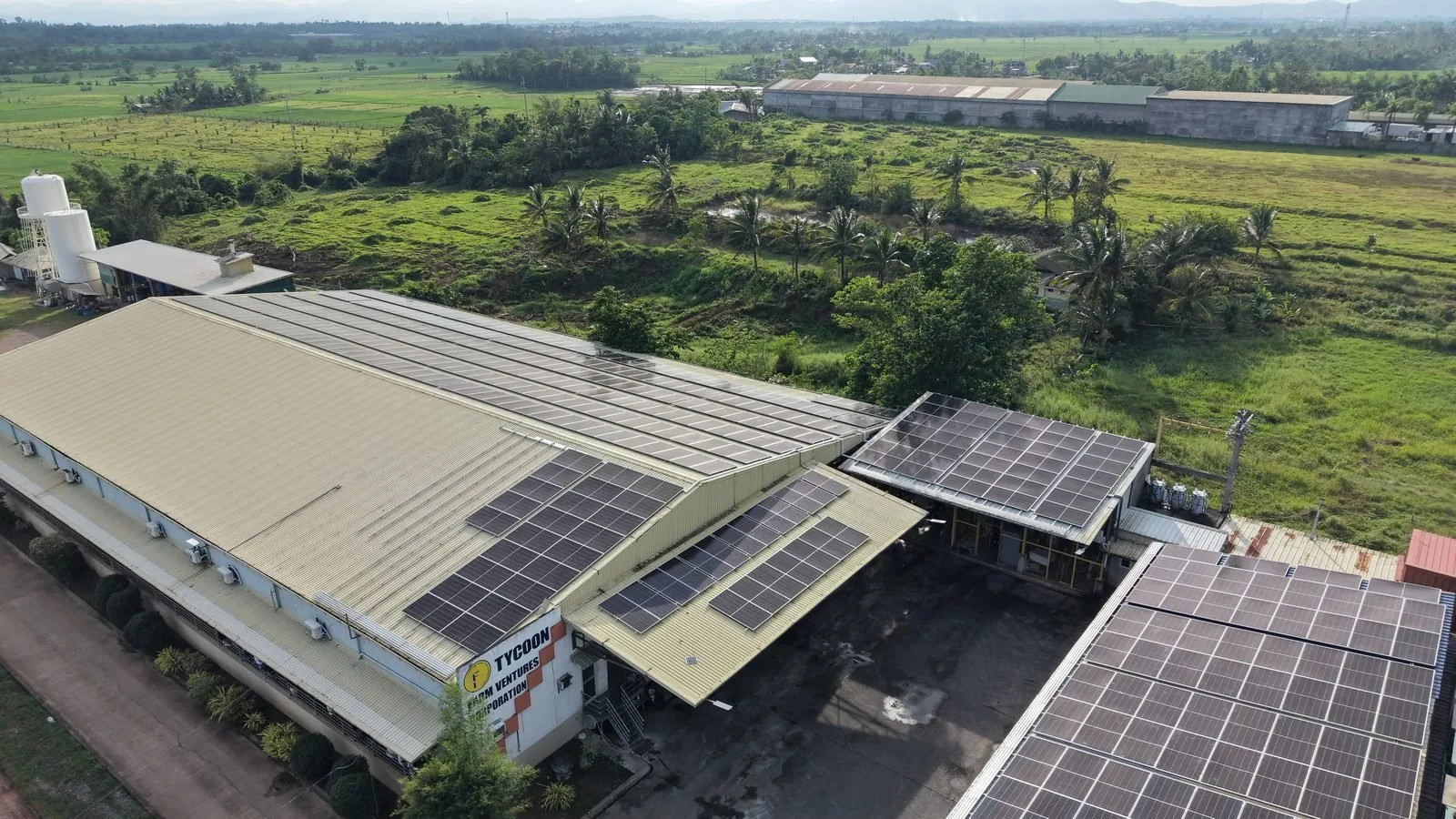
Tariff, capacity-cap and regulatory figures are the published ranges cited above, checked October 2026, and are not measurements of your site. Photograph from Force Solar installation records. Every system is sized against its own load data.
Sizing a similar system?
Send the load profile, the contracted capacity and the destination port — we will respond with the engineering inputs needed for a proposal.
Request a system proposal