Grid-tied, off-grid or hybrid: which solar system actually fits your site?
One question decides it — what happens to your supply when the utility stops delivering. What each type costs, what it cannot do, and why off-grid is so often the wrong answer on a site that already has a connection.
Quick answer: which solar system type is right for a commercial site?
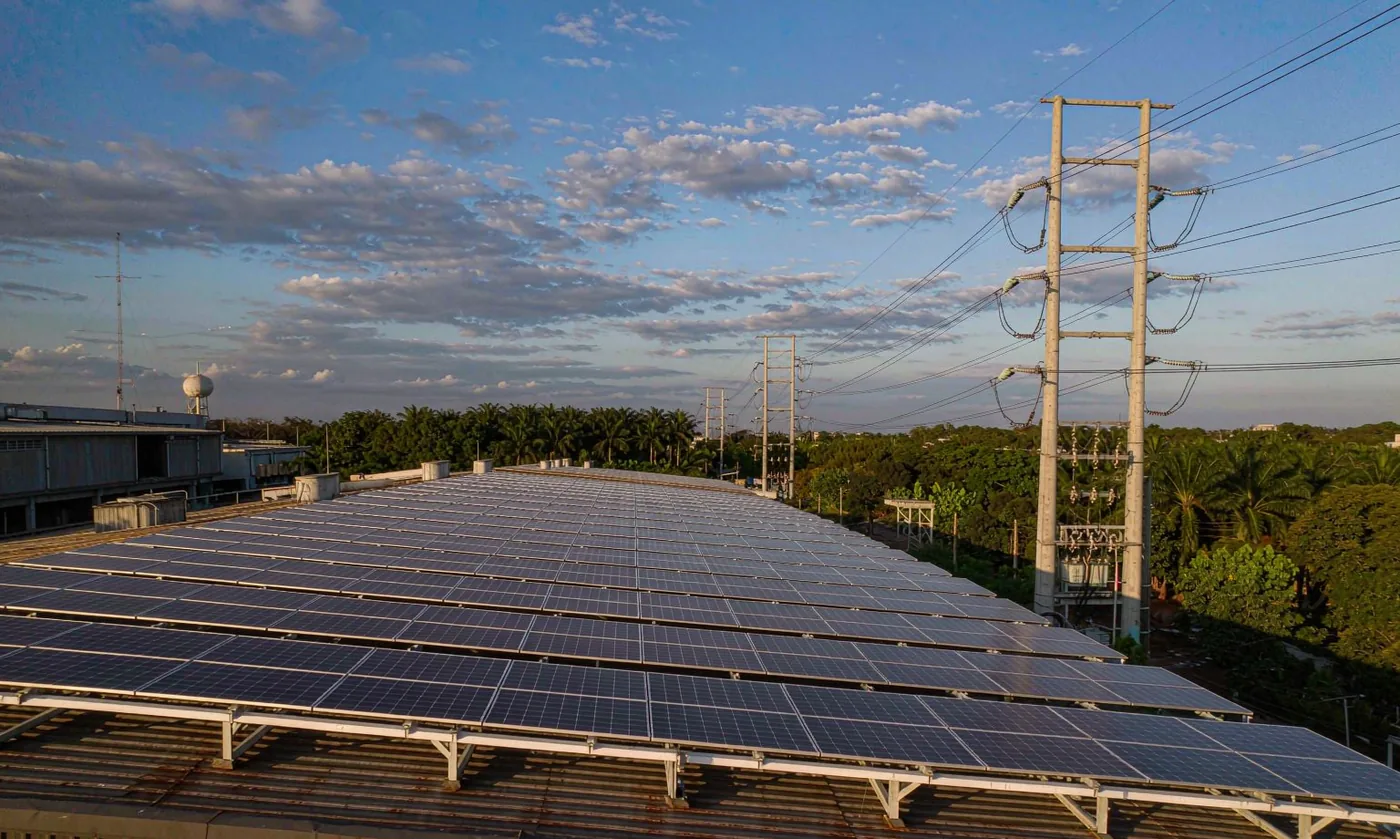
For a commercial or industrial site in these markets, the default answer is a hybrid solar system. Grid-tied is the cheapest per kilowatt and the correct answer only where outages are rare and the utility pays a meaningful rate for export. Off-grid is correct only where there is no usable utility supply at all, or where the site cannot tolerate an interruption and has no generator to fall back on. Everything else is a hybrid system, and the question stops being “which type” and becomes “how much battery, doing what”.
The grid decides the type, not the load
Buyers usually start with the load. The load tells you the size. The grid tells you the type, and the type is the more expensive decision.
Three questions settle it, and they are answerable from the site’s own records rather than from an opinion:
- How many hours a day is the utility actually usable? Not connected — usable. Sites that are connected but spend large parts of the working day on a generator are not grid-tied sites in any meaningful sense.
- Can the load move? A cold store cannot. A water pumping station can. Loads that can shift into the solar window need less battery, and less battery is what makes a hybrid system affordable.
- Is there already a generator? If there is, a hybrid system can be designed to work with it rather than replace it, which changes the battery requirement entirely.
Answer those three and the type usually picks itself. Answer none of them and the cheapest quotation wins, which is how sites end up with a grid-tied system that spends every outage doing nothing.
The three solar system types compared
| Grid-tied solar system | Off-grid solar system | Hybrid solar system | |
|---|---|---|---|
| What it is | Panels, inverter, connected to the utility. No battery. | Panels, charge controller, battery bank, inverter. No utility connection. | Panels, hybrid inverter, battery, utility connection, and usually a generator input |
| Runs during an outage | No. Anti-islanding shuts it down | Yes, up to the battery’s capacity | Yes, for the loads wired to the backup circuit |
| Export to the utility | Possible, where the utility allows it | Not applicable | Possible, on most units |
| Battery cost | None | The largest line item | Significant, and it is the variable you size |
| Typical sizing driver | Roof area and daytime load | Autonomy days and worst-case weather | Backup hours required, plus load that can shift |
| Failure mode | Everything works except the hours you needed it | Oversized battery, or an under-sized one discovered in the rainy season | Complexity at the battery, inverter and generator interface |
| Best fit | Reliable grid, daytime-heavy load, export available | No usable grid, or no tolerance for interruption and no generator | Grid present but not dependable — most of these markets |
Grid-tied: cheapest per kilowatt, and the most fragile
A grid-tied solar system is the lowest-cost way to generate a kilowatt-hour, because it carries no battery and no transfer equipment. Every kilowatt-hour it produces is either consumed on site or exported.
Its limitation is not a design flaw, it is a safety requirement. An inverter must stop feeding the grid when the grid is down, so that it cannot energise a line a technician believes is dead. That is why a grid-tied system is worthless during an outage — not because the panels stopped working, but because the inverter is legally and physically required to disconnect.
That trade is correct in a market with a stable grid and a fair export rate. It is a poor trade on a site that loses supply several times a month, because the site pays for a system that is idle at exactly the moments it is most valuable.
Specify a grid-tied solar system when: the utility is usable essentially all day, the load is concentrated in daylight hours, export is permitted and paid at a rate worth modelling, and there is either no outage exposure or a generator that already covers it.
Off-grid: the most expensive way to buy independence
An off-grid solar system has to do everything: generate, store, and carry the site through the worst weather the location produces. The battery bank is sized for autonomy — days of no useful sun — not for an evening. That single requirement is what makes off-grid the most expensive per kilowatt-hour of the three, and it is why off-grid is so often the wrong answer for a site that already has a utility connection.
The failure pattern is consistent. An off-grid system is quoted against average consumption, the battery is sized for one night, and the first stretch of overcast weather exposes the gap. The site then runs a generator anyway — so it paid for autonomy it does not have, plus a generator it still needs.
Specify an off-grid solar system when: there is no utility connection to speak of, or the connection is so unreliable that it is not worth designing around; the site has no generator and cannot add one; the load is modest and predictable; and the buyer accepts that the battery bank is the dominant cost and will need replacing within the system’s life.
There is one honest middle case: a site that is technically connected but receives supply so rarely that treating it as off-grid produces a simpler, more predictable system than pretending the grid is a resource.
Hybrid: the default answer in these markets
A hybrid solar system keeps the utility connection, adds a battery, and puts a hybrid inverter between them. It generates, it rides through outages for the loads you choose, it can accept a generator input, and it can still export where export is allowed.
The reason it is the default here is not that it is theoretically better. It is that the grid in most of these markets is present but not dependable, and a hybrid system is the only type that prices that reality in without discarding the grid entirely.
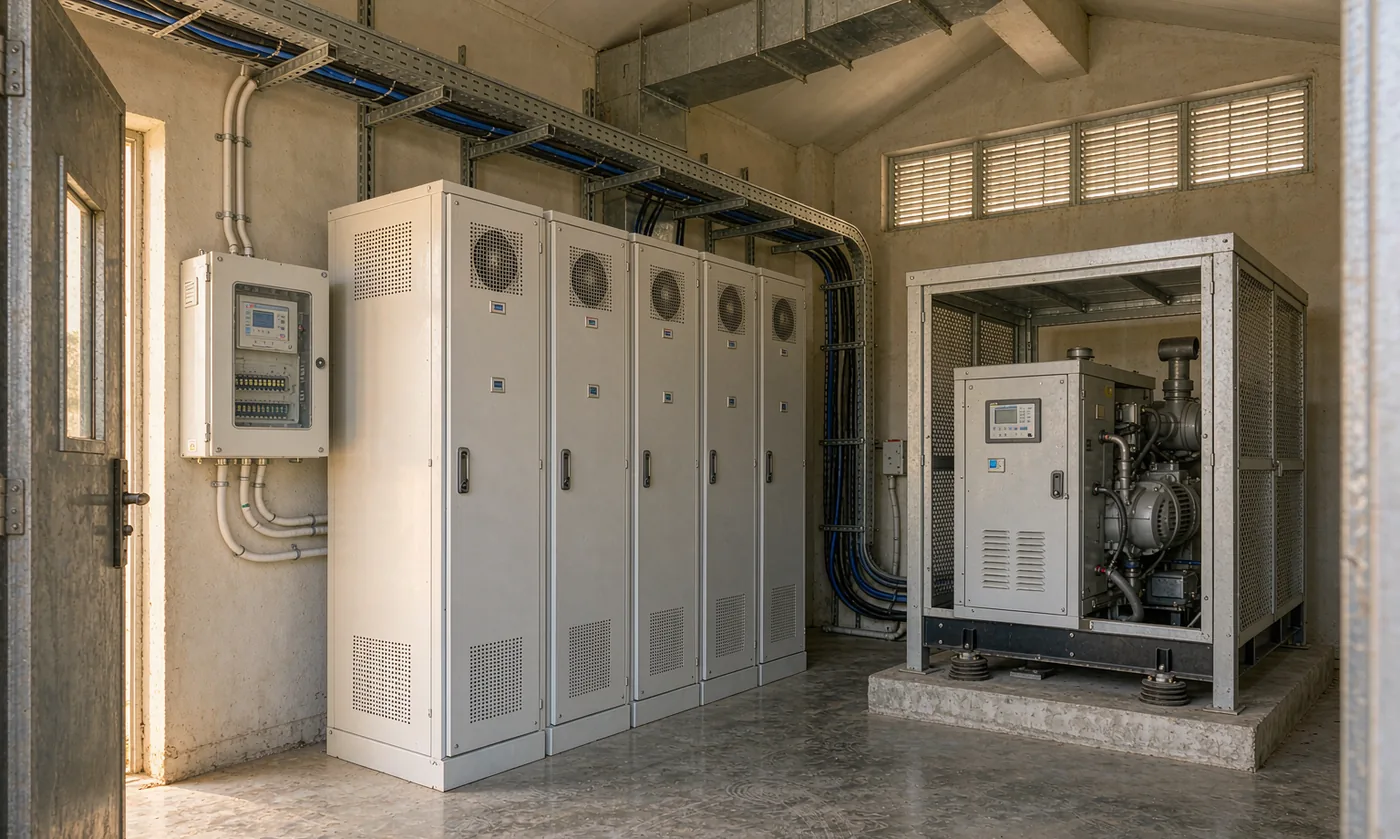
Three things have to be decided at specification time, and all three are expensive to change later:
- Which loads stay on during an outage. Not the whole site, in most cases. A hybrid system is usually designed around a backup circuit — critical loads only — because sizing a battery for the whole site’s peak is how the budget breaks.
- What the battery is allowed to do. Backup only, or also peak shaving, or also soaking up cheap or excess solar. A battery sized for backup and then asked to shave peaks will be undersized for one of the two jobs.
- How the generator behaves. If the site has one, the hybrid inverter has to be specified to accept generator supply, and the changeover has to be engineered. This is a design item, not a wiring detail.
A hybrid system is also the type that most often gets mis-specified in the same direction: the array is sized to the roof, the battery is sized to the budget, and the two are never checked against the load curve that actually has to be carried.
Three tests that separate a real design from a quotation
- The outage test. List the hours you actually lost last month, and what they cost. If that number is small and the grid is stable, a grid-tied system is defensible. If it is large, a grid-tied system is buying the wrong thing.
- The shift test. Which loads can be moved into the solar window without changing how the business runs? Every load you can shift removes battery from the design, and battery is the line item that decides whether a hybrid system pays.
- The replace test. Whatever battery the design carries, ask when it will need replacing and what that costs. A payback calculation that ignores battery replacement is not a payback calculation, it is an opening offer. See how to calculate a commercial solar payback period.
Common mistakes in choosing a solar system type
- “Off-grid is more independent, so it must be better. Independence you do not need is cost you cannot recover. An off-grid system on a site with a usable utility connection usually costs more than a hybrid system doing the same job.
- “Hybrid just means grid-tied with a battery. The battery changes the inverter, the protection, the changeover and the commissioning. It is a different system, not an accessory.
- “The battery is for outages. On many commercial sites the battery earns more by shaving a demand peak than by covering an outage. Which job it does should be a decision, not an assumption.
- “We can add the battery later. Sometimes true, and worth checking per model: a grid-tied system’s inverter usually cannot accept a battery at all, so “later” means replacing the inverter as well.
Procurement checklist
Ask the supplier to state, in writing, for the type proposed:
- Which system type is being proposed, and why it fits this site rather than a generic one
- The hours of usable utility supply assumed, and where that figure came from
- Which loads are on the backup circuit, and which are not
- Battery chemistry, usable capacity, and the depth of discharge at which the warranty applies
- Expected battery replacement interval, and its cost, in the payback model
- Whether the inverter is export-capable, and what the utility requires before it can export
- How the system behaves when a generator is running
- The anti-islanding and changeover arrangement, and who is responsible for commissioning it
- Efficiency and derating across the actual operating temperature range
- What voids the warranty, and where a claim is handled
- Commissioning test results, including a measured outage transfer
Frequently asked questions
What is the difference between a grid-tied, off-grid and hybrid solar system?
The difference is what happens when the utility stops delivering. A grid-tied system shuts down with the grid. An off-grid system has no grid connection at all. A hybrid system keeps supplying selected loads from a battery, and can usually also accept a generator.
Which solar system is best for a factory?
In most of these markets, a hybrid solar system. Factories here usually have a grid that is present but unreliable, and a hybrid system is the only type that covers the outage without discarding the grid. Where supply is genuinely stable and export is paid, a grid-tied system is cheaper and simpler.
Is off-grid cheaper than hybrid?
Almost never, for a site that already has a connection. An off-grid system has to size its battery for days of poor weather, because it has nothing to fall back on. A hybrid system only has to size for the outage it is expected to cover.
Can I add a battery to my grid-tied solar system later?
Check the inverter model before assuming so. Many grid-tied inverters cannot accept a battery at all, so adding storage later means replacing the inverter as well. If a battery is likely within the project’s life, decide the type now.
Does a hybrid solar system work during a total grid failure?
Yes, for the loads wired to the backup circuit. It does not usually carry the whole site, because sizing a battery for the site’s full peak is what makes the design unaffordable. What stays on is a design decision, and it should be written down.
How long can a hybrid solar system run without the grid?
That depends on the battery’s usable capacity and the load connected to it, and both are design inputs. Ask for the backup duration at a stated load, not a single headline number.
Can a hybrid solar system work with my diesel generator?
Yes, if it is specified for it. The inverter has to accept generator supply and the changeover has to be engineered. Connecting both to the same bus and hoping is not a design.
Does an off-grid solar system need a generator?
In practice, many do — for extended poor weather that the battery cannot cover. If a generator is going to be there anyway, a hybrid system is usually the better fit, because it uses the grid when the grid works.
Will a grid-tied solar system reduce my bill during an outage?
No. It is required to disconnect. That is a safety requirement, not a limitation of the equipment.
Which solar system type has the lowest maintenance?
Grid-tied, because it has no battery. A hybrid solar system adds battery monitoring and, eventually, battery replacement to the maintenance plan. An off-grid system adds the largest battery bank of the three.
What decides the battery size in a hybrid solar system?
The backup load and the hours you want to cover, plus any peak-shaving duty you assign it. Both should be stated. A battery sized on budget rather than on duty is the most common specification error in this category.
Type descriptions follow the standard definitions used in grid-interconnection practice: anti-islanding behaviour, backup-circuit design and battery/inverter compatibility. No electricity tariff figures are used on this page, because the comparison is structural rather than economic — the type of system a site needs is decided by grid availability and load flexibility, not by a tariff. Tariff and payback arithmetic for specific markets is covered in the linked articles. Last reviewed October 2026. Photographs are illustrative.
Choosing between the three?
Send the hours of usable grid supply, the load profile, and whether a generator is already on site. We will tell you which type the site actually supports.
Request a proposal