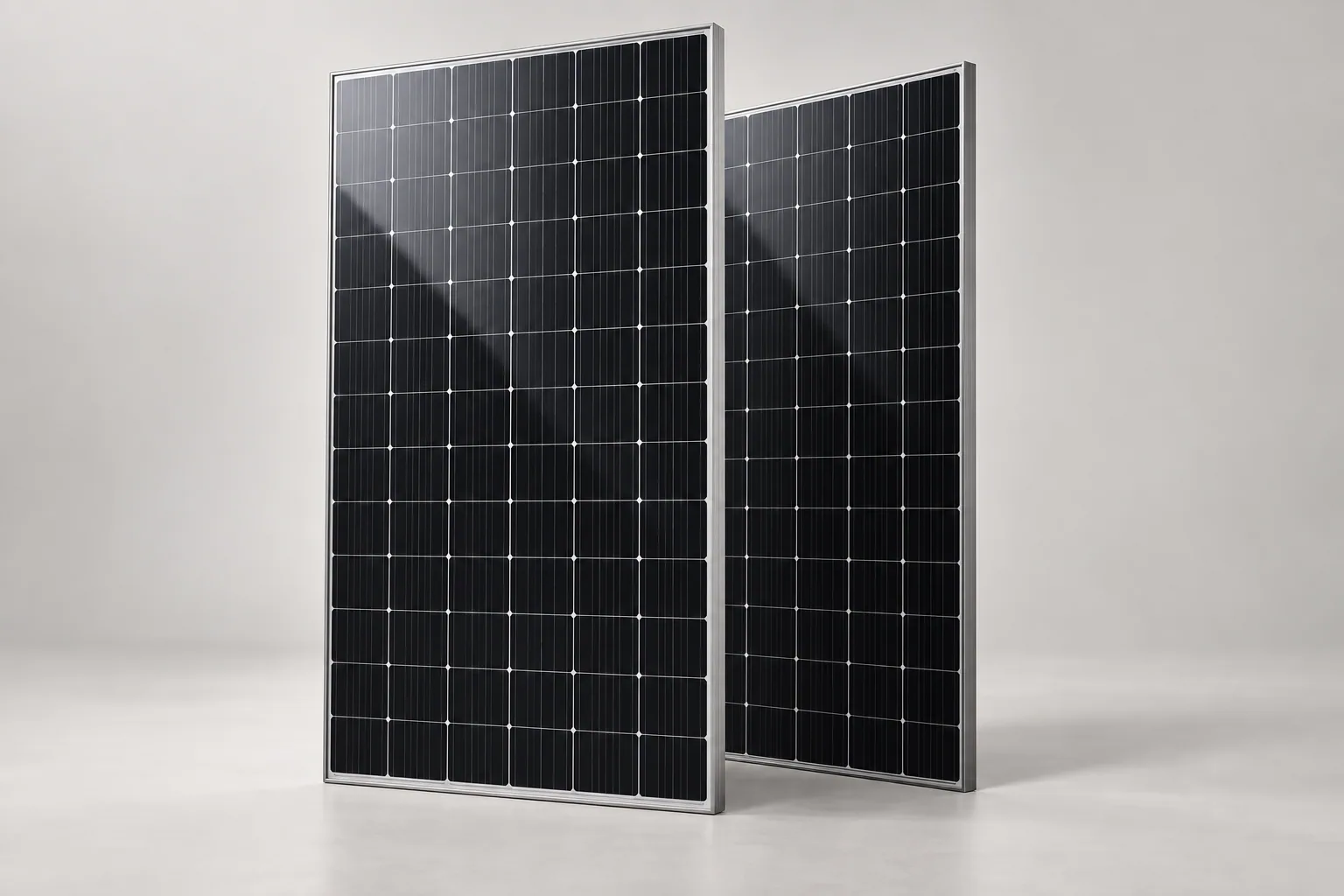
Solar panels form the generation side of a solar power system. Module technology and dimensions should be chosen alongside inverter voltage windows, site layout and applicable model documents.
Final equipment, capacity, model availability and local compliance are confirmed against the project brief and destination.
EQUIPMENT SCOPE
Product selection.
A useful proposal names each component and explains how it fits into the complete system.
Component
Selection basis
Module technology
Selected for available space and project priorities
Electrical ratings
Voltage and current matched to string design
Mechanical design
Dimensions, mounting and environmental loads
Documentation
Exact model datasheet and applicable certificates
ENGINEERING INPUTS
What we need to size it.
Give us the facts you have; the remaining questions can follow in engineering review.
These answers describe system selection. Final equipment and compliance depend on the agreed model and destination.
Which panel type should I choose?+
Compare module dimensions, electrical ratings, warranty terms and certificates against the site design rather than choosing on wattage alone.
Can panels from different models be mixed?+
Mixing requires careful string and inverter design and is generally not assumed in a standard package.
How it is sized
Capacity first, then hardware. Working through these steps in order is what keeps a quotation honest — each one narrows the answer the next one depends on.
Start from the available area
Module choice begins with how much usable roof or ground exists and how it can be mounted. Area, not the wattage on the datasheet, is what sets what the array can physically deliver.
Match the electrical design
Voltage and current have to fit the string design, and dimensions have to fit the mounting system and the local environmental loads. Two modules with the same rating can behave very differently inside a given string.
Compare on paperwork, not just watts
Compare module dimensions, electrical ratings, warranty terms and certificates against the site design rather than choosing on wattage alone. The destination market usually decides which certificates actually matter.
FIT CHECK
Where this fits — and where it does not
Saying what a product is not for is usually more useful than another list of what it can do.
Situation
Verdict
Extending or replacing an existing array
Form factor and string behaviour matter most
Space-constrained rooftops
Higher-efficiency modules chosen for the available area
A module datasheet is measured under standard test conditions. A roof is not. These are the four mechanisms that close the gap, and none of them is a defect — they are design inputs.
Why a live array produces less than its nameplate
Cause
What it does
What to do about it
Heat
Cells lose voltage as they get hotter, so a hot roof produces less than the same module in a cool test
Allow for ventilation behind the array and expect the hot-season figure to be the honest one
Soiling and dust
A film on the glass reduces the light reaching the cell
Set a cleaning interval that matches the site; dry and dusty locations need more of it
Shading
A shaded part of a string affects the whole string, not only the shaded module
Survey the roof at the times of day that matter, not just at noon
String mismatch
Modules of differing behaviour in one string pull the output toward the weakest
Keep strings consistent, and treat additions to an existing array as an electrical question, not just a mechanical one
BEFORE SHIPPING
Documents to settle before the order ships.
Panel selection is settled on paperwork as much as on watts. These are the items to agree while the order is still on paper.
The exact model datasheet
Not a family brochure — the datasheet for the model that will actually be shipped, with the electrical ratings the string design was built around.
Certificates for the destination market
The evidence has to match the market the container is going to. A certificate that covers a different market does not help at customs or at inspection.
Mechanical and environmental ratings
Dimensions, mounting method and the loads the frame is rated for. These decide the racking, and racking is ordered before the modules arrive.
Frequently asked questions
How long does it take to deliver the Solar Panels?
End to end, 4–12 weeks. Requirement definition takes 1–3 days, system design 1–2 weeks, production 1–3 weeks, then every unit completes a 72-hour test before shipping, and shipping and installation take 2–6 weeks depending on the destination.
Is the Solar Panels configuration fixed?
No. What is shown on this page is the reference configuration for the model — every system is sized against its own load data before it is quoted.
What testing does the Solar Panels go through before shipping?
A 72-hour test. It is the fourth of five steps in our delivery process: requirement definition, system design, production, testing, then shipping and installation.
What is included in the Solar Panels price?
Every item named on the quotation, together with export packing and the documentation set. Not included: sea freight, import duties and taxes, and site labour. Each quotation lists these on separate lines, so you can compare suppliers on the same basis.
Is installation included with the Solar Panels?
Not as on-site labour. Our scope: the equipment as specified, tested before it ships, with the drawings and documentation your contractor works from, plus remote commissioning support and spare parts. Your scope: the base and civil works, crane placement, AC cable runs, the grid-connection cabinet and metering, local permits, and the installation labour. We do not keep installation crews abroad, so site work and its cost are quoted by your own contractor or local EPC.
START A PROJECT
Ready to design your solar power system?
Share the site load, location and required backup time. We will define the information needed for a useful proposal.